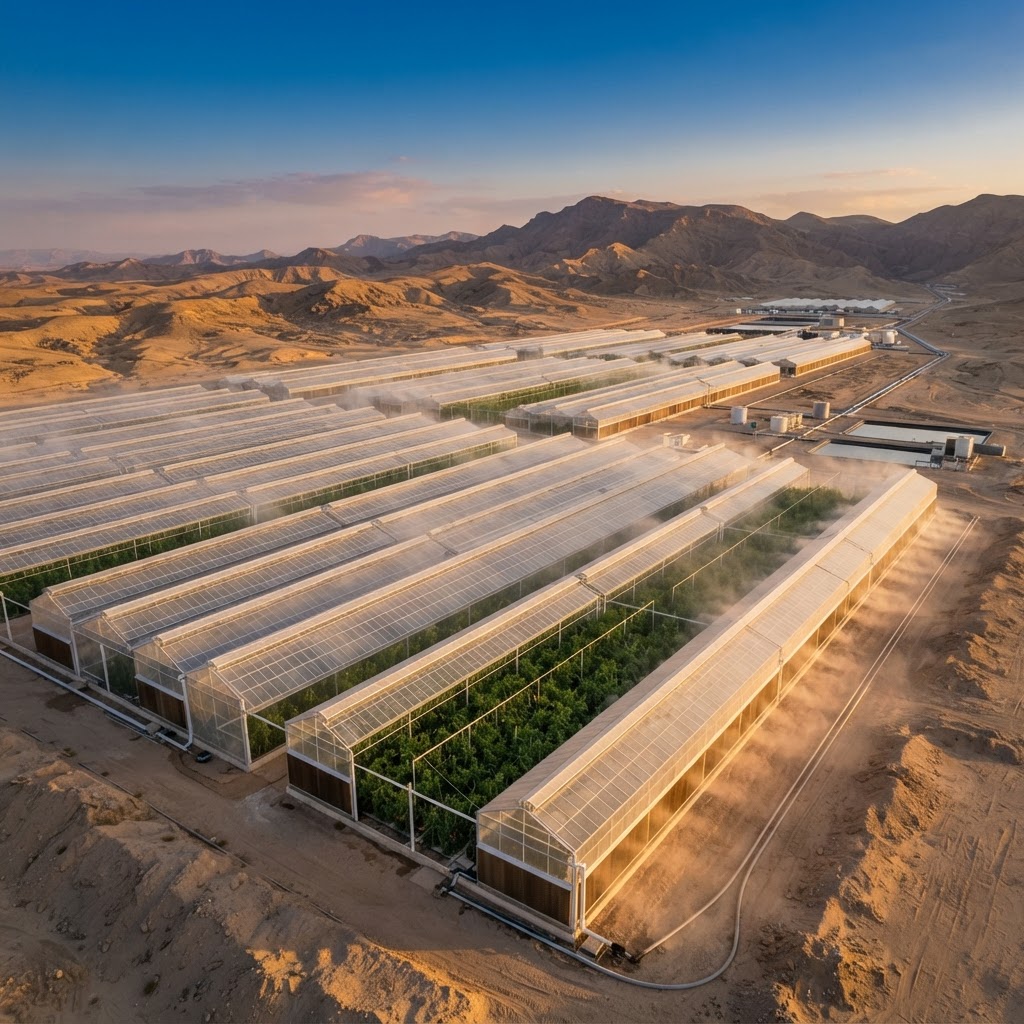
The Green Revolution
2.0
Solving water to green the desert and feed the next 6 billion people
How It Works
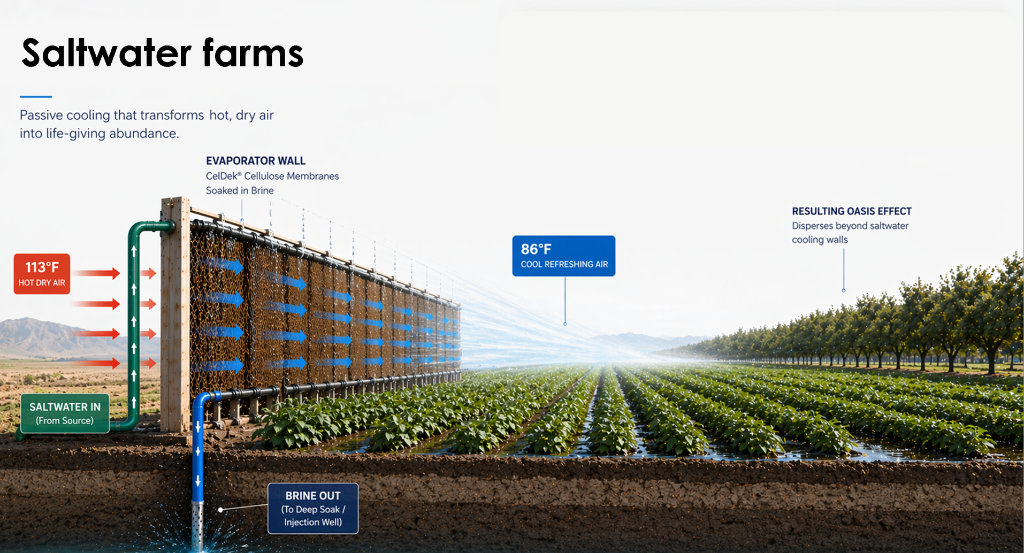
Salt for Water.
A Simple Trade.
No desalination. No complex chemistry. Just the physics of evaporation — proven for millennia — deployed at farm scale with modern engineering.
A Difference That Makes a Difference
85% of Water Goes to Farms.
That's Where the Answer Lives.
Agriculture is the overwhelming majority of Southwest water use — which is exactly why a solution that reclaims farm water moves the needle, and why drip irrigation and desalination, despite decades of investment, never have. They treat the symptoms. We treat the 85%.
Colorado River Water Use
Agriculture
Farms — overwhelmingly flood-irrigated
Industrial / Power
Cooling, mining, energy production
Residential
All cities, households combined
Source: Bureau of Reclamation / USGS Southwest water use estimates
Beyond the Farm Gate
Regional Transformation
at Scale
The effects of evaporative brine cooling don't stop at the farm fence. At scale, they compound — transforming the regional climate.
Phenomenon 01
The Oasis Effect
⚡ Oman Test Site — Unexpected Side Effect
Seawater Greenhouse Ltd. built their Oman site to test the cooling system. Nobody planted anything nearby. Then the grass appeared — spontaneously. Wild vegetation sprouted in bare desert that had seen zero rain, zero irrigation. Moisture output alone triggered growth.
"These effects don't add — they multiply."
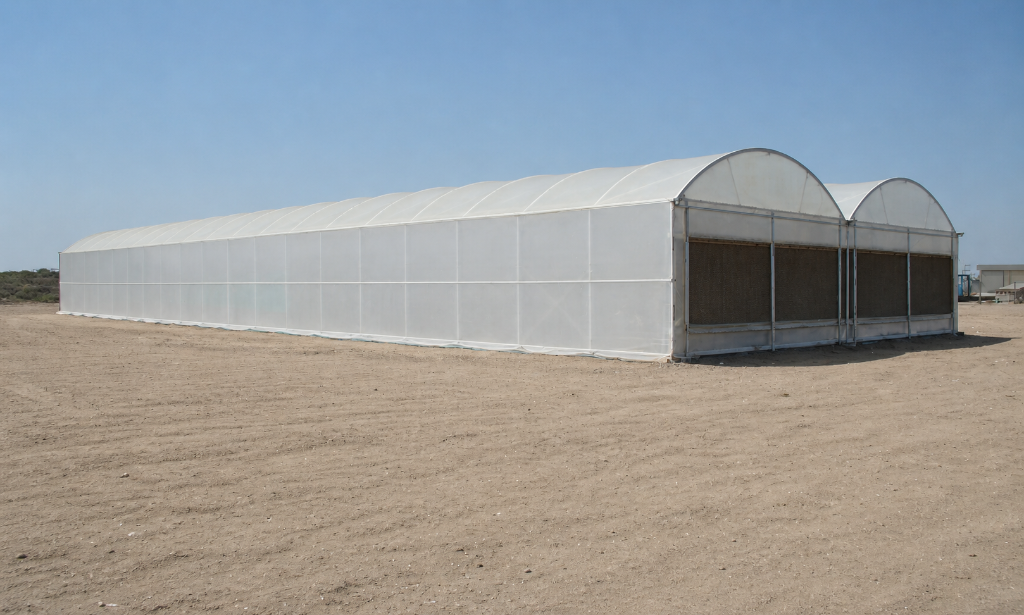
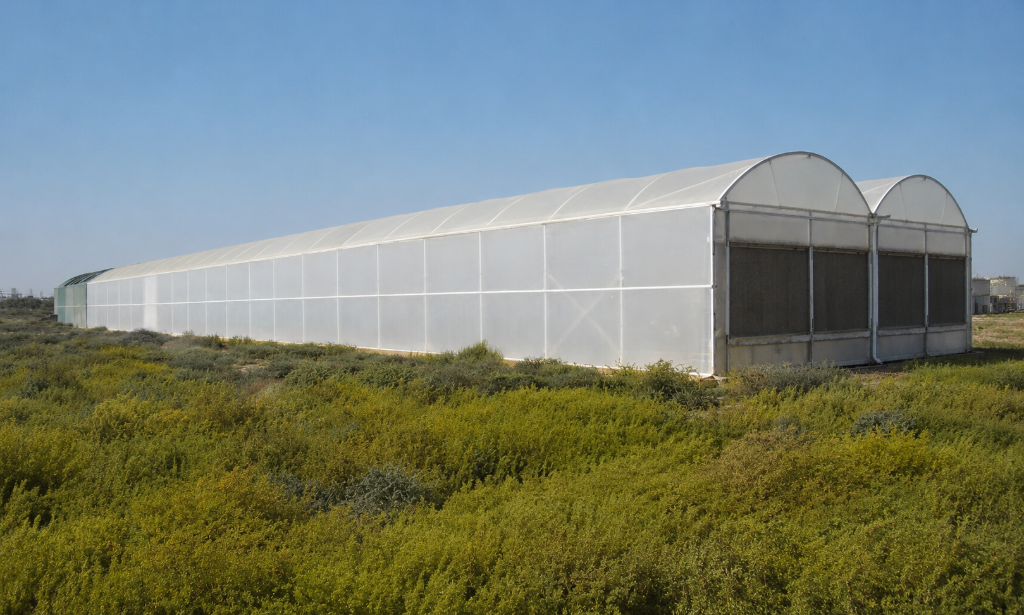
Drag to compare — before & after evaporative brine cooling
Phenomenon 02
Rainfall Effect in the Colorado River Basin

Colorado River Basin — headwaters to delta
Widespread brine evaporation adds moisture to the atmosphere — moisture that moves inland, rises over surrounding mountains, and seeds precipitation back into the region. The Sahel and Arabian Peninsula have already shown this: large-scale surface moisture changes measurably shift regional rainfall within 5–10 years.
"More evapotranspiration initiates a positive feedback loop — more moisture, more clouds, more rain — reversing desertification at the regional scale."
— Synthesized from IPCC AR6 & Brovkin et al.
The Stakes
The Region Saltwater Farms Could Save
Without intervention, the Southwest's collapse continues — dust storms, fallowed farmland, dead rivers. With widespread adoption, the same region becomes something else entirely.

Farms Under Pressure
Mandatory water cutbacks force farmers to fallow fields. Yields decline. Heat stress shortens growing seasons. The most productive agricultural land in America is going idle.

Dust Bowl 2.0
Drying soils, abandoned fields, and relentless desert winds turn the Imperial Valley and Yuma into a new dust bowl. The nation's winter salad bowl becomes a wasteland.

A Thriving Region
Cooler air, retained soil moisture, and spontaneous vegetation return. Farms produce more on less water. The region becomes a model for arid-climate agriculture worldwide.
The Business Case
Not Just Sustainable —
Profitably So
Saltwater Farms creates three compounding revenue streams on top of existing farm operations. The math works before you count the environmental benefit.
Higher Value Crops
Improved microclimate conditions increase yields and enable upgrade to higher value crops — lettuce, spinach, herbs — that command 3–5× the price of commodity crops grown in summer heat.
Cooler temperatures extend growing seasons by months, enabling multiple harvests per year.
Land Value Increase
Infrastructure improvements drive higher land values for resale. Farms equipped with cooling wall systems become demonstrably more productive and resilient assets.
Improved land productivity translates directly into higher appraisal value and better financing terms.
Water Rights Sales
Reduction in freshwater consumption through substitution with saltwater enables sale of freed-up water allocations. Water credits sell at near 99% margins.
In Arizona and California, water rights trade for $1,500–$5,000+ per acre-foot — creating a powerful secondary revenue stream.
The Economic Flywheel
Solving scarcity for profit
Build Farms
Deploy cooling walls
Save Water
40–80% freshwater saved
Sell Water
Rights at ~99% margin
Generate Profit
Compounding returns
Scale
More farms, more impact
The Precedent
It's Been Done Before.
Can We Repeat the Feat?
1900 — Global Starvation
The world was running out of food.
By 1900, every continent faced the same ceiling: not enough nitrogen to grow enough food. Farmers exhausted soil. Empires strip-mined Pacific islands for seabird guano. Malthus seemed right — population would outgrow the planet's ability to feed it.


1909 — The Breakthrough
Fritz Haber literally turned air into fertilizer.
Atmospheric nitrogen makes up 78% of the air we breathe — but crops can't absorb it. Haber discovered a catalyst to fix it into ammonia. Carl Bosch scaled it at BASF. An invisible, "worthless" gas became the foundation of modern agriculture.
Result — Half the World Fed
6 billion people fed. An empire built.
Haber–Bosch now underpins a third of all global food production — feeding over 6 billion people who could not otherwise exist. BASF became one of the most dominant chemical companies on earth, powering the German economy to this day. One "worthless" molecule. Infinite leverage.

Two individuals solved world hunger. What if two people could do the same for water?

Today — Water Crisis
The Southwest is running out of water.
Agriculture consumes 85% of the region's freshwater, yet desert heat evaporates a staggering portion of it before it ever reaches a crop. Lake Mead is at historic lows. The Colorado River is approaching dead pool. The clock is running.
Today — The Breakthrough
Underground brine — written off for centuries.
Vast saline aquifers run beneath the entire desert Southwest — too salty for crops or cities. Zero market value. But pump it to the surface and let desert wind evaporate it, and it cools the air by 20–40°F — slashing the heat that steals the water.


Result — Water Supply Saved
40–80% less freshwater. For every farm that joins.
The worthless becomes the solution. Each farm that switches to evaporative brine cooling frees up enormous freshwater allocations — allocations that can be sold back at near 99% margins. Scarcity becomes profit.
The Team
A Modern Partnership
Like Haber and Bosch — one the inventor, one the industrialist — we collaborated to combine deep agricultural innovation with the operational expertise to create a globally scalable enterprise.

Charlie Patton
Seawater Greenhouse
Charlie is the inventor behind the evaporative cooling wall technology, refined through years of work with Seawater Greenhouse — a pioneer in using seawater and solar energy to grow crops in arid coastal environments. His breakthroughs in deploying brackish and saline water for agricultural cooling form the scientific core of Saltwater Farms.

Jason McBride
E2Eden
Jason brings the Silicon Valley mindset to bear on humanity's greatest challenges. Through E2Eden — "A New Dawn for Dead Seas" — his mission is to deploy innovations that are not only world-changing but profitable, mobilizing capital markets to fund planetary-scale solutions. Like Carl Bosch, he builds the engine that takes the innovation to civilization-defining scale.
The Mission
"To creatively connect, combine and deploy non-speculative technologies and innovations to engineer our way to water abundance, revolutionizing agriculture and rescuing cities across the US Southwest and one day — the world"
— E2Eden Mission Statement
Roadmap
From Pilot to Planet
We start where the need is most acute, prove every number with real data, then build the infrastructure to deploy at scale.

Phase 1
Proof of Concept
Timeline
2026 – 2027
Deploy a single cooling wall system on a partner farm in the Imperial Valley or Yuma area. Rigorously instrument every variable.
Measure actual air temperature reduction across 500–1,000 ft downwind
Track freshwater savings vs. control plot over full growing season
Validate crop yield and quality (lettuce, spinach, herbs)
Establish unit economics: cost per acre-foot of water saved
Independent third-party data verification for investor credibility
Milestone Deliverable
Peer-reviewed dataset + economic model → triggers Phase 2 funding

Phase 2
Turnkey System Development
Timeline
2027 – 2028
Engineer a modular, deployable system that any farmer can purchase and install. Build the supply chain, manufacturing, and support infrastructure.
Standardize wall panel design for rapid deployment
Develop proprietary brine-compatible pump and media systems
Build digital monitoring platform (water savings dashboard)
First commercial installations on early access depositor farms
Establish water credit brokerage partnerships
Milestone Deliverable
Commercially available Saltwater Farms System — priced per acre of coverage

Phase 3
Regional Scale Deployment
Timeline
2028 – 2030
Roll out across Imperial Valley, Yuma, and Phoenix Basin. Establish water credit marketplace. Begin international licensing.
10,000+ acres under Saltwater Farms management
Water credit sales generating $M annual farmer revenue
Expand into Jordan Valley, Australia pilot programs
Policy partnerships with Bureau of Reclamation, USDA
Franchise model for rapid international deployment
Milestone Deliverable
Category-defining agricultural infrastructure company
Global Opportunity
Where Brine Meets Need
The pattern repeats everywhere: hot, dry climate + saline aquifer + stressed freshwater supply + farmland. These regions don't need more freshwater. They need a smarter way to use what they have underground.
Farm Dead Seas & Deserts Worldwide
Every evaporating salt body on Earth is a potential brine source. Every adjacent desert is a potential farm. These locations share a common trait: abundant saline water, desperate freshwater scarcity.

Imperial Valley & Coachella, CA
Supplies 90% of U.S. winter vegetables. Facing mandatory Colorado River cutbacks of 20–40%.
Immediate — largest water-stressed farming district in the U.S.

Arizona: Yuma & Phoenix Basin
Arizona faces the steepest Colorado River cuts. Yuma grows 90% of U.S. leafy greens in winter.
Critical — farmers are already fallowing land for water credits.

Jordan River Valley
One of the world's most water-stressed regions. The Dead Sea is shrinking by 1 meter per year.
Jordan, Israel, and Palestine share a river at a fraction of its historical flow.

Australian Outback
Massive saline aquifer systems underlie much of inland Australia. Extreme heat limits agriculture.
Vast brine resources + existing farming infrastructure in Murray-Darling Basin.

Sahara & North Africa
The Nubian Sandstone Aquifer holds one of the world's largest fossil water reserves — mostly saline.
Morocco, Egypt, Tunisia seeking food self-sufficiency with minimal water.

Atacama & Coastal Chile/Peru
Driest non-polar desert on Earth. Proximity to the Pacific creates unique evaporative dynamics.
Growing water stress threatens copper mining and emerging agriculture.
Get in Touch
Interested in Investing?
We're actively engaging strategic investors and partners who want to be part of the solution to the US Southwest's water crisis. Reach out to start a conversation.
Why Now
Proven Technology
Field-validated by our partners Seawater Greenhouse Ltd. at multiple sites globally. Not a concept — a working system.
Massive Market
$1.5T+ in economic output at risk across the US Southwest alone.
Near 99% Margins
Water rights trading creates a recurring, high-margin revenue stream.
Urgent Timeline
Lake Mead reaches dead pool by end of 2026. The window is now.
Direct inquiries
jasonmcbride@e2eden.com